
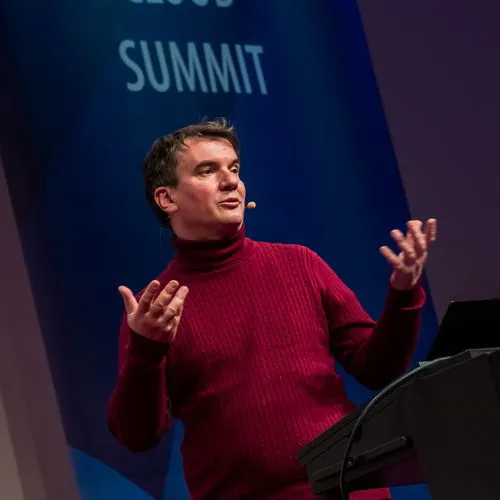
But, why should you listen to me?
Fair question. Let me give you two reasons.
First, I actually organize events. My money is in this. My company has just delivered the largest Microsoft business and technology event in Europe last week, the ECS. I am, quite literally, the kind of employer you would be looking for if you are an event professional currently without work.
Second, I know a thing or two about AI. If you don't want to take my word for it, take Microsoft's: I have been Microsoft Most Valuable Professional for Artificial Intelligence for many years now, and we have been using AI in our events since 2014. No, that is not a typo: 2014.
So if you are looking for someone with feet planted in both worlds, deep in the event industry, deep in AI, and actually employing event professionals, I am that guy. And I can tell you, with some confidence: the advice you have been reading the past two or three weeks will not land you a gig.
AI is genuinely changing events, and there is no way back
AI is massively changing our industry. We are living it every day.
In our own operation, we have reduced post-event data analytics (work that used to take weeks!) to basically nothing. Our marketing has changed completely; everything is hyperpersonalized now. We stopped hiring agencies to build classical event websites. We stopped wasting time on manual matchmaking and the kind of pointless buyer/seller programs that everyone politely pretends are working. All of it has been replaced by AI. I'll write another blog post soon about all the manual work that has been vaporized by AI in the past 5 years, but for now, let's just say it's a lot.
The result? With a handful of people, we deliver cooler events and better and faster outputs than traditional event companies do with tenfold headcount.
So yes, AI is changing the event landscape. Massively. And yes, we are hiring. But the question is what are we actually looking for?
Before I get to that, there is one more thing I need to say, because nobody else seems willing to.
You might be replaced by AI, but it doesn't have to happen
You will have heard the much-repeated line: "You will not be replaced by AI, you will be replaced by someone using AI." It sounds reassuring. It gets a lot of likes on LinkedIn.
But it is simply not true.
A lot of work in event organization is being replaced by AI. Some event companies will let people go because of it. Others will simply stop making new hires and try to retrain or re-educate their existing teams. The expectation now, and this is already the new normal, is to deliver an ever better event experience with an ever smaller team.
I know this is not popular to say. But, as I said before, this article is not written to be popular.
So what would make you interesting in the event market?
I cannot pretend to speak universal truths the way influencers who have never organized an event somehow manage to. 😊 I can only speak from where I sit, as someone who runs multiple successful events a year. But here is what I, personally, am looking for. And I suspect a lot of my colleagues in the industry are looking for the same thing.
Help us expand the business. Bring ideas, and the operational execution to back them up, that lead to more registrations, more ticket sales, more sponsorship deals and exhibitor packages. Sales is the one thing AI will not replace, but AI can absolutely supercharge it. How do we expand the circle? How do we make better offerings? If you can answer those questions and then do something about it, we should talk.
Help us reduce costs without hurting the experience. Every event has a few enormous cost centers: venue, catering, tech, marketing. Some of these are immovable. Some can be massively reduced with a clever use of technology, and I mean technology in general, not necessarily AI alone. If you can show how to free up money tied up in lazy assets, and then redirect it into things that actually improve attendee experience, you will be a valuable team member at any event company.
Take things off my plate. Be a doer. Take initiative. Take responsibility. Reliably get stuff done. Sounds simple, almost boring, and yet this is one of the rarest profiles to find. Anyone who fits this description is welcome on every event team I know of.
Bring new ideas. Events are increasingly turning into communities. What will those communities look like? How can we use new technologies, AI included, to bring people together, facilitate meaningful connections, and deliver more value to everyone involved? This is a massive shift in our industry, and you need to be ahead of it. If you can help event companies execute on that shift, you are exactly what they need.
About that "advice" you keep reading and everyone seems to repeat
Let me go through some of it.
You will have read that you should spend seven or eight hours a day learning AI tools. This makes no sense. Prompting is by now a necessary skill for every professional, in almost every industry, so yes, learn it, get fluent. But don't make it your whole pitch — it's not a differentiator anymore (if it ever was).
The most ridiculous thing I read recently is that learning to integrate MCPs with legacy platforms is what will land you a gig in an event company. I am 100% sure that people writing this kind of "advice" have no idea what MCP actually is, but it seems like a cool buzzword to repeat. We have been working on AI integrations for the past 24 months, and yes, MCPs play a role, but they are one piece in a much larger puzzle. This is not a job for an event professional turned AI enthusiast. This is a job for a principal or senior software architect with deep experience in event platforms. If by some miracle you happen to be that person, and you are without work, please, contact me immediately.
You will have read that you should charge half of what your competitors charge. This is the worst possible advice anyone can give you. I will not even dignify it further.
Also, anyone telling you to start your own event as a way out of unemployment (which always means a massive upfront financial investment), and telling you to make it "AI resistant" in the same breath as telling you to learn MCP servers, cannot be taken seriously.
And you will have read that you should get off social media and start doing things. Said, of course, by people who post five times a day on LinkedIn. 😊
Connect with practitioners.
You would not take marriage advice from an unwed counselor, so why would you take career advice in the event industry from someone who is not putting their own money into running events?
Instead, connect (in real life!) with event companies and event professionals. Go to where they are. Talk to them. They will tell you what is actually needed, and how their work is changing from one month to the next. They are the ones with the genuinely good advice.
But you need to accept that a lot of the old traditional ways of working in events are simply not needed anymore. Intelligent event management platforms are taking away enormous amounts of manual work. We like to think run.events is the most advanced of the bunch, but there are others on the market doing this too. The trend is only accelerating. Companies that stick to the old ways (the notebooks, the Excel sheets, the dozen small "specialized" tools...) will not be able to compete. And, deep down, they know it.
The world of events is changing, and there is no way back. So, find your place in this new world. Think hard about how you can contribute, how you can make yourself invaluable. Once you do that, the rest tends to take care of itself.
Be ahead of the wave. Not behind. Not even on top of it. Ahead of it.